

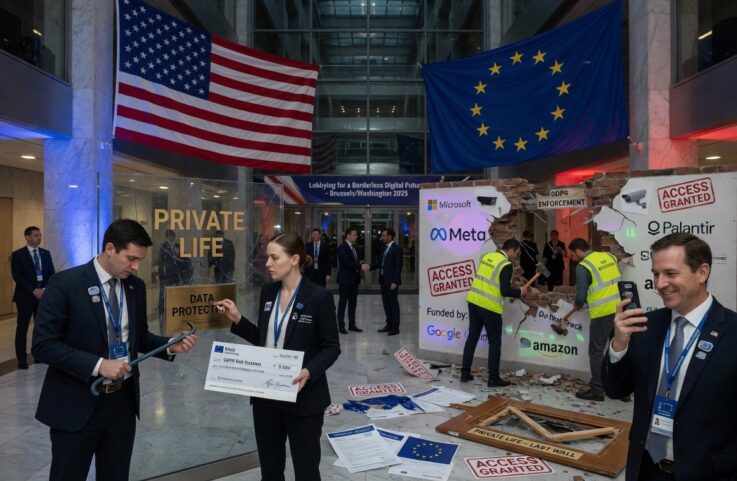
The push for online age verification sounds like the most reasonable thing in the world. Who could possibly argue against protecting children from harmful content? That's precisely the point. When a policy is framed as a moral imperative, few people stop to ask who is actually writing the legislation, who funds the nonprofit groups cheering it on, and who profits when every user on the internet is forced to prove who they are before they can so much as browse a website. The answer, once you trace the money and the lobbying trails, is deeply uncomfortable.
Follow the money long enough and the altruistic idea cracks. Meta, the same company currently on trial for deliberately engineering addictive experiences for minors, has spent over $2 billion funneling grants through nonprofit shells to push age verification legislation across 45 U.S. states. The shell organizations don't carry Meta's branding. They carry names that evoke parent groups, child safety foundations, and civic advocacy, the kind of names that get sympathetic coverage and sympathetic hearings before state legislatures. When Louisiana's Representative Kim Carver introduced HB-570, a bill requiring age verification at the app store level, she publicly confirmed that a Meta lobbyist had handed her the legislative language directly. The bill's genius was in who it targeted: Apple and Google's app stores had to verify ages, Meta's own platforms did not. In tech policy terms, that's not child protection, that's a precision strike against your competitors.
Across the Atlantic, in Brussels, the pattern repeats. Meta has publicly endorsed Macron's proposed "digital majority age" framework, calling for "robust age verification mechanisms" to be implemented at the "app store or operating system level". Google, not wanting to be left behind in shaping the terms of its own regulation, open-sourced Zero-Knowledge Proof (ZKP) libraries in mid-2025, framing it as a privacy-preserving verification innovation. These are two of the most powerful companies on earth, apparently racing to regulate themselves. In reality, they are racing to set the terms before anyone else does.
The World Economic Forum has long provided the intellectual infrastructure for this kind of convergence. At Davos, the language of "digital trust," "safe digital futures," and "identity-first infrastructure" has been normalized for years, creating the ideological runway for exactly what is now being built into law. The coordination between tech lobby groups like DigitalEurope (whose membership includes Amazon, Google, and Meta) and EU Commission officials mirrors the pattern we saw during the pandemic response: synchronized messaging, pre-drafted legislative text, and media pressure that makes dissent look irresponsible. Someone, somewhere, is giving the hivemind its marching orders.
Here is a blunt commercial truth: bots and fake accounts are devastating to the advertising revenue of social media giants. When a significant portion of "impressions" and "engagements" on a platform are generated by automated accounts, advertisers pay for attention that doesn't exist and audiences that aren't real. Platforms lose pricing leverage. Brands demand refunds. Age verification, mandated at scale and tied to government ID, is the “cleanest” possible solution to this problem and it generates a massive secondary benefit that nobody in a press release will ever mention. Once every user is verified as a real human with a confirmed identity, the data that platforms collect about that person becomes infinitely more valuable. Right now, a social media profile is a probabilistic model of a real human. After mandatory identity verification, it becomes a fully fledged dossier. Advertisers, governments, intelligence agencies, and corporate research clients will pay premium for that. Every ad served, every search made, every post liked, maps back to a verified individual. You don't just know someone is interested in hiking gear. You know exactly who is, their real age, their registered address, and their entire digital behavioral history.
There is an uncomfortable technical reality that politicians rarely acknowledge in their public statements: true age verification is virtually impossible without a digital identity system. You cannot confirm that a person is over 18 from a self-reported birthday. You cannot do it meaningfully with a credit card check, since minors borrow parents' cards constantly. The only mechanism that actually works is binding an online account to a government-issued identity credential. Once that link is established, your social media account isn't just your social media account anymore. It's a node in a government-readable identity graph. Countries are already moving in this direction: Turkey is implementing a system that requires users to provide identity documents and citizenship numbers to access social media, with major platforms having already agreed to the terms. EU officials are building a wallet-based identity layer that connects to everything from age-gated websites to national digital wallets.
And here's the part that should concern everyone: if your digital identity is what grants you access to social media, and that identity is administered by a state, then the state can also revoke that access. The connection between digital identity and Central Bank Digital Currencies (CBDCs) is rarely covered in mainstream reporting, but it is formally acknowledged in financial regulatory documents. The Bank for International Settlements notes that proof of identity (‘Know Your Customer’ compliance) is a prerequisite for onboarding any user to a CBDC system. The OECD's own research paper on CBDCs and democratic values explicitly flags the lack of formal digital ID as a barrier to implementing it. In plain language: a programmable, government-issued digital currency, which can be restricted based on what you purchase, when you spend it, or what your social credit profile looks like, requires a digital identity to function.
An investigation by Investigate Europe, published in April 2026 and reported by major outlets including The Guardian, Le Monde, and Die Zeit, reveals that Microsoft and DigitalEurope successfully inserted a confidentiality clause into a 2024 EU directive governing data center energy reporting. A first draft of the regulations had required that energy usage, water consumption, and efficiency data for individual data centers be published. Microsoft and DigitalEurope submitted almost identical amendments classifying this information as "commercially confidential". When the European Commission published its final text, the industry's proposed article had been copied nearly word for word
"The fact that the Commission copy-pasted a Microsoft amendment is shocking," said Bram Vranken of the Corporate Europe Observatory. "Who does the commission really represent: Big Tech or the public interest?" Ten leading legal scholars told Investigate Europe that the clause likely violates the Aarhus Convention, an international treaty guaranteeing public access to environmental information. The EU's data center capacity is set to triple in the next five years, with €176 billion in investment expected. Communities living near these facilities dealing with water stress, land use changes, and power grid strain are legally blocked from finding out the precise environmental footprint of any individual facility. Citizens must submit to total transparency: verified identity, confirmed age, traceable behavior. The corporations and institutions demanding that transparency are simultaneously writing secrecy into law for themselves.
On April 14, 2026, Ursula von der Leyen stood before cameras to announce the launch of the EU's Digital Age Verification App. "It is for parents to raise their children. Not platforms. No more excuses," she said. Two days later, UK-based security consultant Paul Moore published a video on X showing a complete bypass of the app's authentication in under two minutes. All it required was physical access to a phone and editing the app's configuration files, resetting the PIN, disabling biometric checks, while the original verified age credential remained intact. The incident is instructive on two levels. The first is technical: a system this fragile should not be the foundation for a continent-wide digital identity architecture. The second is political: the EU rushed a broken product to market because the political timeline mattered more than the security baseline.
Australia's social media ban for teens under 16, which took effect on December 10, 2025 and threatens platforms with fines of up to $49 million for non-compliance, has produced results that should embarrass every politician who supported it. According to research by the Molly Rose Foundation (an NGO that supports internet restrictions) 61% of 12–15-year-olds who previously held accounts on banned platforms continue to have active ones, and 70% of those children said bypassing the rules was "easy". Even Australia's own eSafety Commissioner conceded last month that "a substantial proportion" of underage users are still creating and retaining accounts on Facebook, Instagram, TikTok, Snapchat, and YouTube. That’s where the lobby groups for OS age verification come in. They use the failed policy in Australia to support implementing age verification at a device level.
Lobby groups, big tech corporations, and NGOs backed by corporate money are collectively dismantling the last walls of private life. Big Tech gets authenticated premium user data. Governments get a permission lever over who can speak online. Financial institutions get the identity rails that CBDCs require. And children get a verification app that a security researcher bypassed in the time it takes to make a cup of coffee.