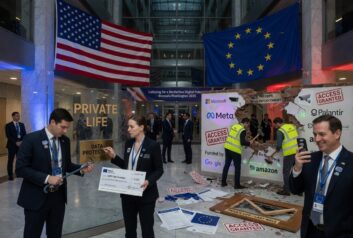

On the surface, the Barcelona summit looked like any other European leftist lunatic gathering. But the Barcelona agenda is being pushed forward by an ecosystem where NGOs function as policy testing grounds and parties as the electoral vehicles, all funded through a mix of EU programs, national budgets, and global foundations such as those linked to George and Alex Soros. So this is not just about ideology. It is about cash, contracts, and compliance.
Let’s start with the messaging they pushed for two full days. The panels weren’t subtle.
One FEPS fringe event (run by the official PES think tank) was titled “Gender, Politics, and the Understanding of Equality among Generation Z.” Friedrich-Ebert-Stiftung (FES) co-hosted it, dissecting how to sell gender ideology to teenagers who are already pushing back.
Another session: “Reclaiming the progressive narrative on migration” featured the Progressive Migration Group and PES, framing open border policies as a human rights imperative while ignoring housing shortages, wage depression, and cultural tensions playing out in real European neighborhoods.
On climate, FES Just Climate and the SOLIDAR network ran panels on “Renewing progressive leadership in climate and industry,” pushing “just transition” and accelerated decarbonization. The same script that’s driven Europe’s energy prices through the roof while China keeps building coal plants.
At the top of the political pyramid stands Pedro “Dirty” Sanchez, leader of Spain’s PSOE and Prime Minister of Spain. Pedro Sanchez was on stage defending his plan to hand legal status to roughly 500,000 undocumented migrants, calling opposition “xenophobia” and declaring Spain “the children of migration.” His party is a core member of the Party of European Socialists (PES), which in turn belongs to the Progressive Alliance of Socialists and Democrats (S&D) in the European Parliament.
This is important for two reasons:
- EU party money follows PES: S&D‑linked parties receive public funding from the European Parliament, with roughly 90% of the amount tied to their MEP count and 10% as an equal lump sum. PES received about €9 million in EU public funds in 2023 and the same structure applies in 2026.
- PES hosts campaigns and seminars: Under the slogan “Europe for the People”, PES has organized dozens of campaigns in schools and local dialogue events across Romania, Hungary, Bulgaria, and other EU states, often in partnership with umbrella NGOs.
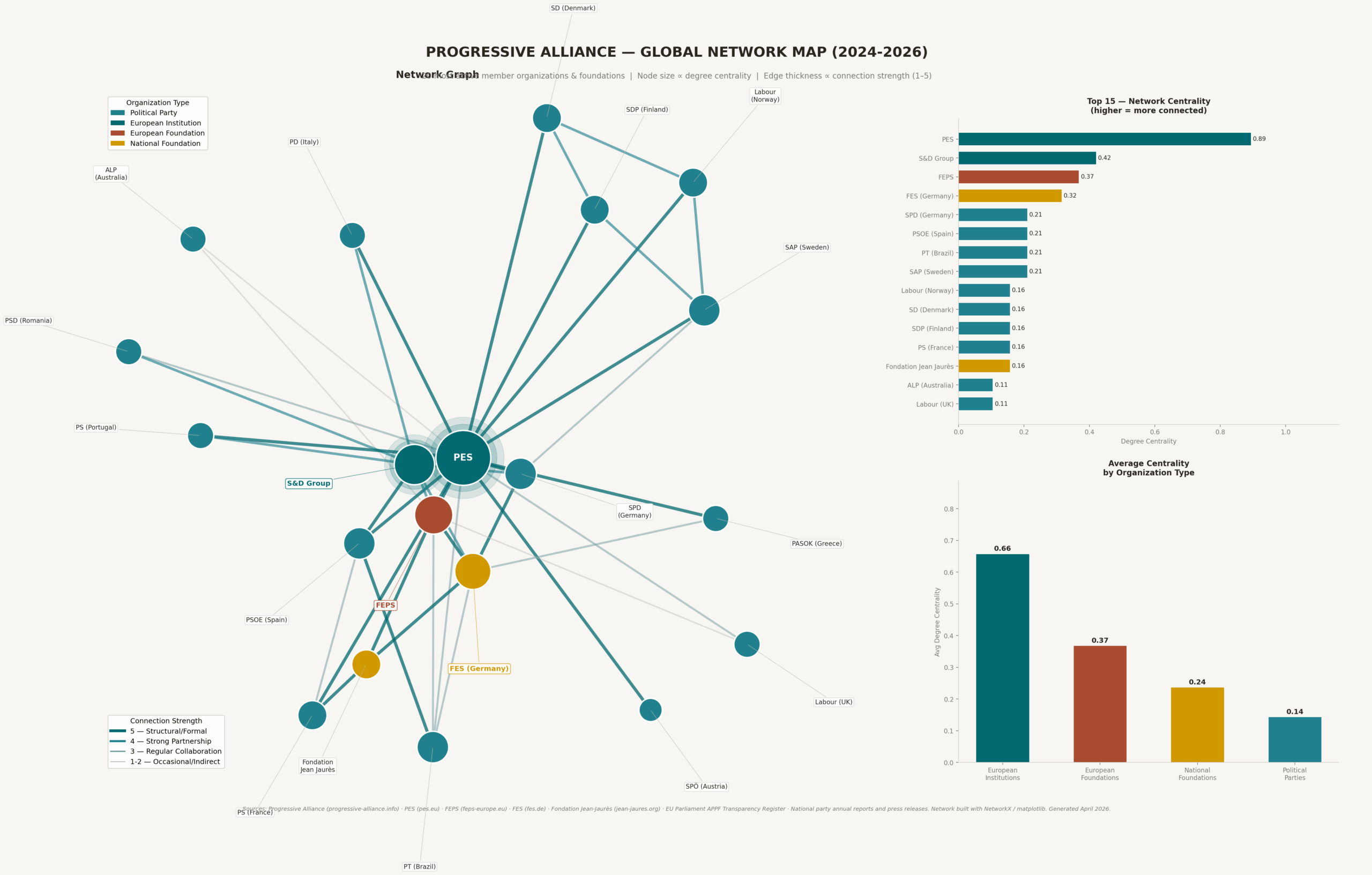
Meanwhile, the Progressive Alliance (PA), the global network of social democratic and progressive parties and organizations, operates in parallel. Its own statutes list ordinary membership fees and voluntary contributions from members and sympathizing organizations as its main income sources. In practice, this means PA linked parties and NGOs pay dues while also securing project specific grants from an EU level.
The PA’s own “Partners” list includes dozens of NGOs and foundations, not just parties:
- Foundation for European Progressive Studies (FEPS) – A Brussels based think‑tank that produces policy papers and legislative blueprints used by PES and S&D MEPs.
- Friedrich Ebert Stiftung (FES) – The German social‑democratic foundation that runs political‑education centers, training programs, and NGO‑support projects from Bucharest and Constanța to Budapest and Sofia.
- Foundation Jean Jaurès – French leftist foundation funding dialogue forums, media support, and local governance experiments across Central and Eastern Europe.
- Olof Palme International Center – Swedish funded NGO network backing social‑movement and left‑leaning organizations in post‑Soviet states.
- Solidar – Transnational network of social solidarity and trade union linked NGOs, often co‑financing social inclusion projects in the EU.
- International Union of Socialist Youth (IUSY) – Youth network associated with PA and PES, coordinating “youth policy” and “municipal progressive” programs.
Beyond the PA, Barcelona also drew energy from the Global Progress ecosystem:
- Global Progress– Described as an international NGO aiming at the “rational redefinition of societal fundamentals,” focusing on structural reform, welfare redesign, and macro‑policy experimentation.
- Global Progress Initiative/Global Progress Summits - High level forums convened by actors such as Canada 2020, the Center for American Progress (CAP), and Policy Network, often under the patronage of figures like Justin Trudeau.
These networks bring together European social‑democrats, American progressives, EU think‑tanks, and NGOs in closed door meetings that produce joint policy statements and pilot projects. Many of the ideas that surface at Global Progress style summits later reappear as EU‑funded projects in Romania, Hungary, Bulgaria, and elsewhere.
A key node in the Barcelona leftist machine is Alex Soros and his place within the Open Society Foundations (OSF) ecosystem.
OSF linked organizations show up across Europe in:
- Migration‑support networks (legal aid NGOs, asylum info platforms, community sponsorship groups).
- Gender‑and‑minority‑rights coalitions (LGBTQ+ rights groups, “equality monitoring” bodies, HR training NGOs).
- Rule of law and judicial independence projects, often co‑financed with EU level programs.
For example, in the EU funded program “EU Funds for Fundamental Rights – Bulgaria, Czechia, Greece, Hungary, Poland, Romania” project (2024–2026), Validity Foundation coordinates a consortium that includes Bulgarian, Czech, Greek, Hungarian, Polish, and Romanian NGOs, many of which are embedded in the broader progressive network ecosystem. Similar OSF linked groups appear in EU‑funded gender equality and migration integration projects in Romania and Hungary.
In this light, the Barcelona summit is not just Sanchez’ show, it is a coordination hub where OSF linked NGOs, EU funded foundations, and party linked think‑tanks meet to align strategies on migration, gender, and climate policy across national borders.
The real power of the Barcelona network lies in how money flows. Three main channels dominate:
- EU party funding (PES/S&D)
- Around €9 million per year in EU‑public funds to PES, distributed according to MEPs and basic lump sum rules.
- PES then uses part of this to run campaigns in schools, seminars, and “progressive local” events in Romania (Progressive Local Dialogue in Constanța, 2025) and other EU states.
- EU project funding (NGOs and partners)
- Across Romania and beyond, thousands of NGOs receive EU Structural/Cohesion funds, Horizon style research grants, and “fundamental rights” calls.
- These funds often flow via umbrella NGOs (FDSC in Romania, Union of Bulgarian Foundations and Associations) that act as fiscal conduits or technical partners for smaller groups.
- Foundation grants (Soros linked and others)
- Foundations such as OSF, FES, FEPS linked actors, provide multi‑year core grants and project funding to NGOs that later partner with PES linked parties on EU level applications.
In simple terms, this creates a cycle:
- Foundation funds NGO A.
- NGO A co‑applies with Party X for an EU‑funded project.
- The EU‑funded project is implemented by NGOs, while the party claims credit.
- The same NGO A then feeds research and training back into PA‑linked think‑tanks such as FEPS or FES‑affiliated institutes.
A 2025 estimate by the German conservative outlet Achse des Guten claimed that the European Commission had disbursed around €17 billion between 2019 and 2023 to NGOs and lobby groups, primarily leftist and green organizations. Whether that figure is precise or inflated, the direction is clear: EU‑level funds are heavily channeled into progressive civil‑society structures, many of which are aligned with PES, PA, and their NGO‑network.
What makes the Barcelona‑style model so striking is the symmetry between parties and NGOs:
- Parties are elected and accountable (in theory) to voters.
- NGOs are funded by EU bodies, national governments, and global foundations and are often far less accountable than ministries or parliaments.
Yet in practice, NGOs shape the agenda more than many realize:
- They design training programs that local officials use when implementing migration, gender‑identity, or climate‑transition schemes.
- They produce studies that are cited in EU reports, mainstream media and in national parliamentary debates.
- They run campaigns that define what “progress,” “inclusion,” and “solidarity” mean in public discourse.
Some examples from our region:
- FDSC‑type resource centers in Romania, coordinating EU‑funded governance and anti‑corruption projects.
- Bulgarian foundation networks partnering with FEPS‑linked and OSF‑linked groups on social‑inclusion and gender‑equality projects.
- Hungarian NGOs (Validity, Partium Monitoring, NGOs under the Hungarian Helsinki Committee) operating in EU‑funded fundamental‑rights and media‑freedom programs.
These organizations are often promoted as “civil society,” but their funding and policy alignment place them squarely within the progressive party ecosystem. The Barcelona summit is where this alignment is formalized: party leaders share the stage with NGO directors who are, in effect, their policy implementing partners.
The Barcelona summit is a showcase not of spontaneous civil society activism, but of a well connected, well financed progressive party and NGO machine that operates across Europe and into the United States, often without voters fully understanding their implications.